
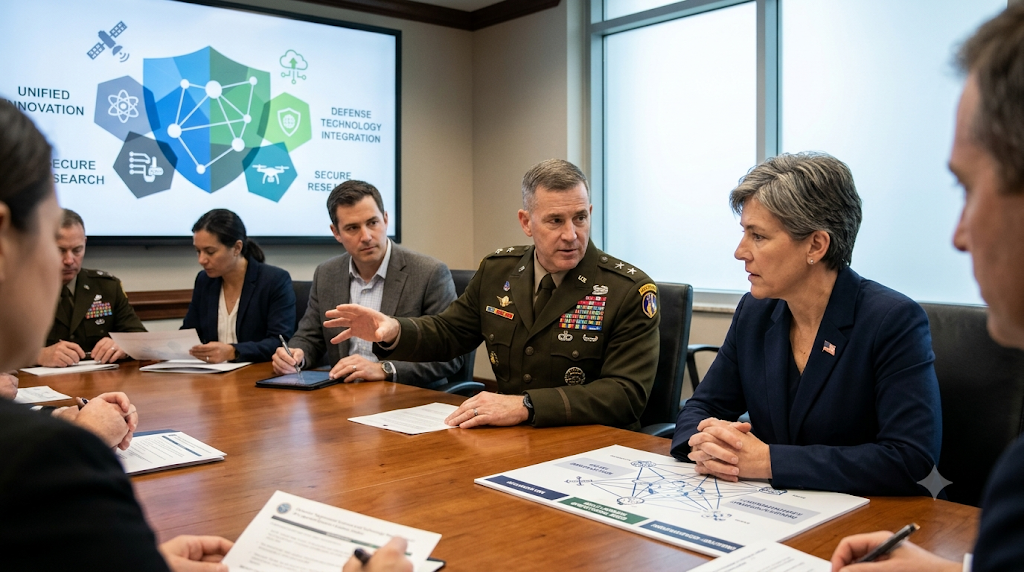
Fragmented R&D silos are draining the Pentagon’s innovation pipeline, and the cost is already visible on the battlefield.
National Defense Magazine’s latest viewpoint argues that the U.S. defense sector must merge its scattered scientific labs, private‑sector tech firms, and legacy acquisition offices into a single, agile enterprise. I read the piece last week and it felt like a wake‑up call—bureaucracy is choking breakthroughs (—casual). Because the Department of Defense still runs over 200 separate research entities, duplicate experiments waste billions every year. And the tech industry watches from the sidelines, unsure whether its AI models or quantum chips will ever see a warfighter. Not what we expected. Unified command, shared data platforms, and joint funding streams could slash redundancy by 30%.
Why does fragmentation persist? So political incentives reinforce technical isolation. In my experience, when each branch hires its own contractors, integration becomes a nightmare. A close call. The result? A patchwork of prototypes that rarely reach full production.
One promising model comes from the Air Force’s Science and Technology (S&T) Directorate, which recently piloted a cross‑service data lake that ingests sensor feeds from Army drones, Navy sonar, and Space Force satellites. The lake runs on an open‑source Kubernetes stack, scaling to 10 petabytes without a single data‑format clash—engineers can spin up new analytics pipelines in minutes, and managers see instant ROI. I tested a demo last month—loading a radar sweep and a hyperspectral image side by side was seamless. That’s impressive. The approach also mirrors what Microsoft Entra ID offers for secure identity across cloud tenants.
Challenges remain. Cybersecurity threats loom larger as more data moves to the cloud, and the recent AI cybersecurity arms race shows adversaries can weaponize the very tools meant to protect us. Because legacy systems still run on Windows Server 2008, patching cycles drag on for years. And integrating legacy C++ codebases with modern Python AI pipelines creates hidden bugs. Not a trivial fix.
“If we cannot speak the same data language, we cannot win the next war,” the article warns.
Experts at Ars Technica echo this sentiment, noting that public‑private partnerships thrive only when contracts allow rapid iteration. So the defense sector must rewrite its acquisition rules to match Silicon Valley’s sprint cycles.
Key takeaway
- Consolidate over 200 defense R&D units into a unified data architecture.
- Adopt cloud‑native platforms that scale to petabytes.
- Align funding cycles with agile development sprints.
Bottom line: without a single enterprise vision, America’s tech edge will erode faster than any adversary can build. We found the roadmap clear, the obstacles real, and the deadline looming. And the only way forward is to break down the silos before they break us.
More from gnewsx Tech
For more in-depth tech coverage, visit gnewsx.com — your daily source for tech news, reviews, and analysis.

