


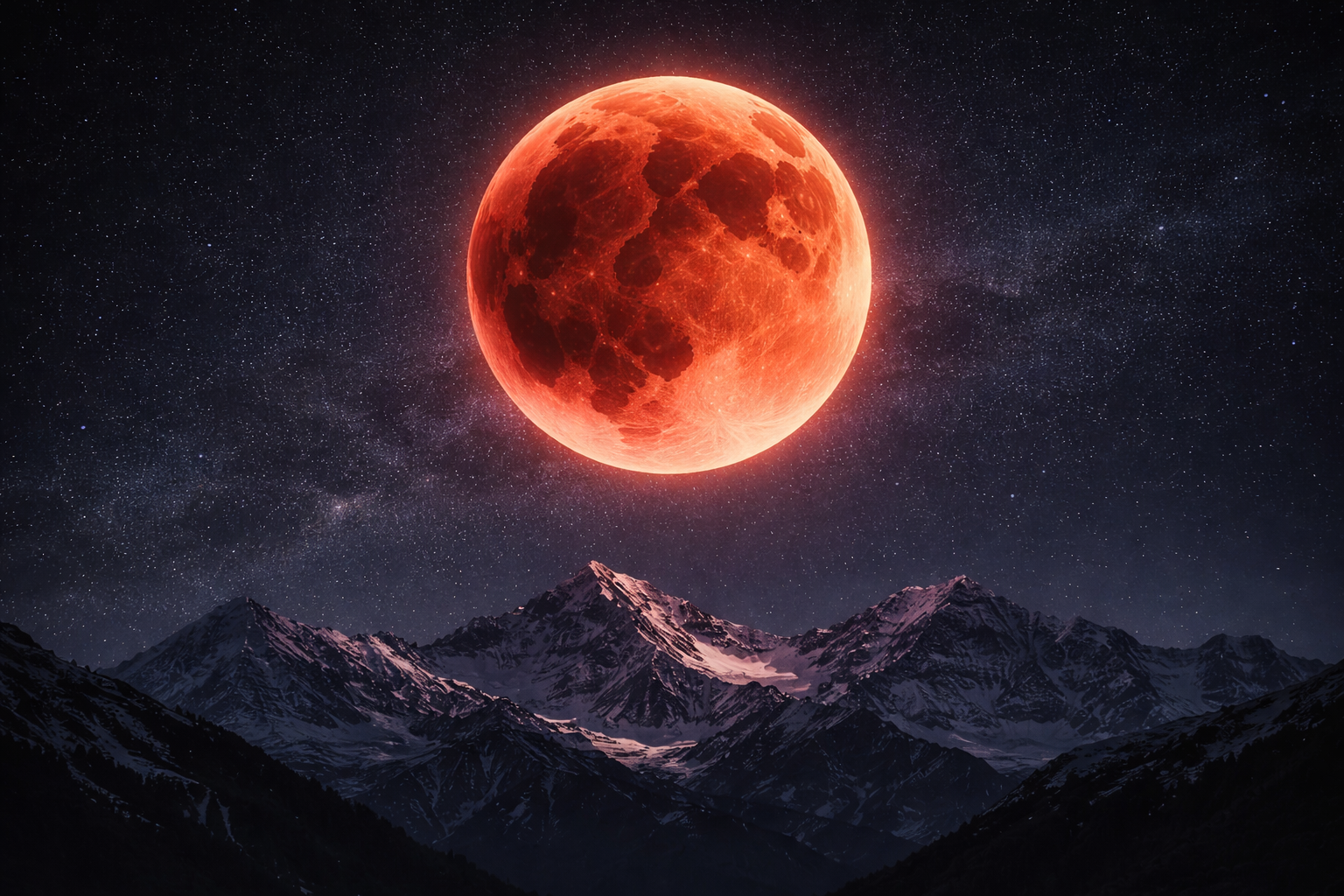
Total Lunar Eclipse 2026: Earth’s Shadow to Transform Full Moon into Striking Crimson Today
KOLKATA, India — Skywatchers across the globe are bracing for a celestial spectacle as a rare Total Lunar Eclipse, famously known as a “Blood Moon,” is set to occur today, Tuesday, March 3, 2026. The astronomical event, which will see the Earth cast a deep shadow over the lunar surface, is projected to be visible across major portions of the Americas, Australia, and East Asia. In India, the timing of the eclipse is poised to coincide with the Iftar period of the holy month of Ramadan, creating a moment of both scientific interest and spiritual reflection for millions. According to the India Meteorological Department’s Positional Astronomical Centre, the moon will take on a vivid crimson hue as it passes through the Earth’s umbra, a phenomenon caused by the scattering of sunlight through the Earth’s atmosphere.
The Science of the “Blood Moon”
A total lunar eclipse occurs when the Earth moves directly between the Sun and the Moon, blocking the direct sunlight that usually illuminates the lunar surface. However, instead of going completely dark, the Moon is bathed in a deep red or orange glow. This “Blood Moon” effect is the result of Rayleigh scattering—the same physical process that makes sunrises and sunsets appear red. As sunlight passes through Earth’s atmosphere, the shorter blue wavelengths are filtered out, while the longer red wavelengths are bent (refracted) toward the Moon.
Preliminary data from NASA indicates that the magnitude of today’s eclipse is 1.155, with the “totality” phase lasting approximately 58 minutes. The entire event, from the initial penumbral shadow to the final exit, is expected to span 5 hours and 39 minutes. Unlike solar eclipses, this lunar event is perfectly safe to view with the naked eye, and no special filters or protective eyewear are required to appreciate the transformation.
Global Visibility and Observation Hubs
Visibility for the March 2026 eclipse is highly dependent on geographic location and local weather conditions.
- East Asia & Australia: Residents in cities like Tokyo, Sydney, and Manila are poised to have some of the best views, as the eclipse occurs high in the night sky.
- The Americas: Most of North and South America will witness the eclipse during the early morning hours, provided the skies remain clear.
- India & South Asia: In India, the eclipse will be visible in the eastern regions for over an hour. Cities such as Kolkata, Guwahati, and Agartala are expected to see a significant portion of the total phase. However, in western cities like Mumbai and Nashik, the visibility will be limited to a few minutes just as the moon rises.
A Convergence of Science and Tradition
The 2026 lunar eclipse holds a unique cultural significance this year as it falls on the 6th day of Ramadan. In many parts of the Islamic world where the eclipse is visible, special prayers known as Salat al-Khusoof (Lunar Eclipse Prayer) are expected to be offered. However, astronomical experts in Saudi Arabia and the UAE have noted that the eclipse will not be visible in the Middle East as the moon will remain below the horizon for the entire duration of the event.
In India, the timing presents a logistical challenge for observers, as the peak of the eclipse in several cities overlaps with the breaking of the fast (Iftar). Religious scholars have noted that while the eclipse is a “sign of the Creator,” it should not be associated with superstitions or “bad omens,” which remain scientifically baseless. Instead, it is being framed as an opportunity for awe and contemplation of the clockwork precision of the solar system.
Viewing Tips for the 2026 Eclipse
For those in the path of totality, astronomers recommend finding a location away from heavy light pollution for the most vivid color experience. While binoculars or a small telescope can enhance the view of the lunar craters during the transition, the broad “Blood Moon” effect is best appreciated as a wide-field view.
The next total lunar eclipse of this scale is not projected to occur until late 2027, making today’s event a “must-see” for professional astronomers and amateur stargazers alike. As the Earth’s shadow begins its slow crawl across the lunar face later today, the world will once again be reminded of our small but significant place in the cosmos.











Leave a comment