


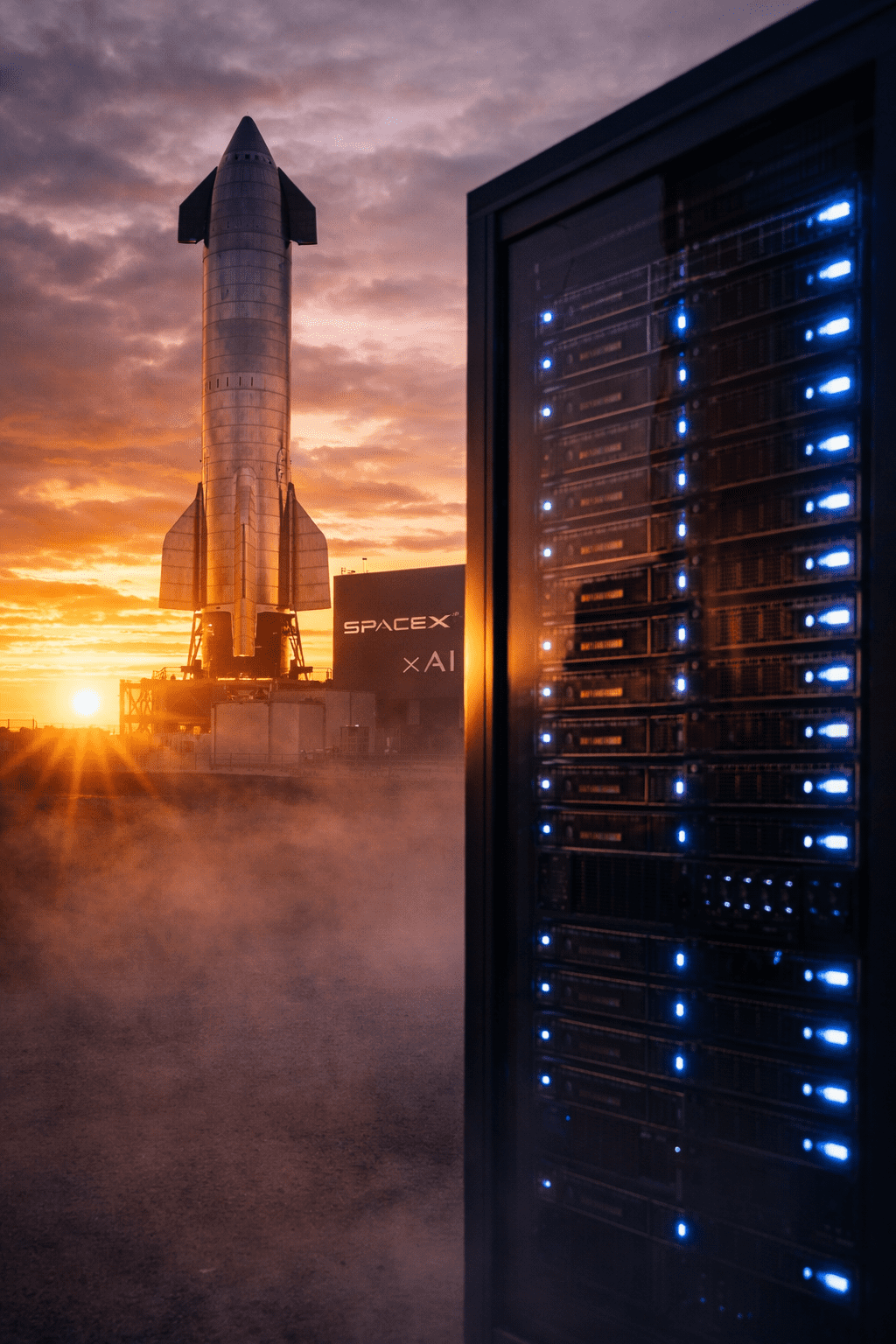
SpaceX Completes Record-Breaking $250 Billion Acquisition of xAI to Anchor New Deep-Space Intelligence Era
BOCA CHICA, USA — In a move that has fundamentally restructured the global technology and aerospace landscape, SpaceX has officially completed its acquisition of the artificial intelligence venture xAI. The transaction, valued at a staggering $250 billion, is projected to be the largest merger in corporate history. Finalized on Monday, February 9, 2026, the deal brings together Elon Musk’s primary aerospace powerhouse and his rapidly evolving AI entity, aiming to integrate advanced neural networks into the next generation of autonomous interplanetary exploration.
The Financial Architecture of a $250 Billion Giant
The closure of the deal follows months of intense regulatory scrutiny from the Federal Trade Commission (FTC) and international competition watchdogs. Based on early financial reports, the acquisition was structured as a multi-stage stock and cash transition, significantly bolstered by SpaceX’s private valuation, which recently crossed the $300 billion mark. Analysts suggest this merger is poised to create a vertical monopoly on “frontier tech,” combining the physical infrastructure of Starship with the cognitive capabilities of the Grok-3 large language models.
The $250 billion figure surpasses the previous inflation-adjusted record held by the Vodafone-Mannesmann merger. For SpaceX, the move is seen as a strategic pivot. While the company remains the world leader in satellite deployment and crewed spaceflight, the integration of xAI is projected to reduce operational costs by automating up to 40% of mission control and trajectory planning through real-time, AI-driven decision-making systems.
Empowering Starship with Autonomous Intelligence
The primary technological objective of this merger is the development of “Physical AI”—a concept where the AI is not just a chatbot but the central nervous system of a spacecraft. Engineers at the Starbase facility in Texas have already begun testing Grok-integrated systems within the Starship prototype framework. This integration is poised to enable autonomous landing on unmapped lunar or Martian terrain without the 20-minute signal delay inherent in Earth-based communications.
According to preliminary technical briefs, the xAI team will now operate as a core division within SpaceX, focusing on “Astrodynamical Computation.” This involves using multi-agent AI systems to manage Starlink’s massive constellation—now exceeding 12,000 satellites—ensuring zero-collision paths and optimizing global internet speeds. The merger is poised to accelerate the timeline for the first uncrewed Mars landing, with some internal projections suggesting a mission could be attempted as early as late 2027.
Market Ripples and the AI Arms Race
The global financial markets reacted with a mixture of awe and caution. While SpaceX is not a publicly traded company, its ripple effects were felt across the semiconductor and aerospace sectors. Shares in major chip manufacturers like Nvidia and AMD saw a sharp uptick as investors anticipated a massive increase in demand for space-hardened AI processors. Conversely, traditional aerospace competitors have seen their market valuations fluctuate as they scramble to match the consolidated R&D budget of the new SpaceX-xAI entity.
In the broader context of the “AI Bubble,” this merger provides a concrete use case for generative intelligence. Critics have long argued that AI lacks a sustainable “killer app,” but Musk has positioned the colonization of Mars as the ultimate utility for super-intelligent systems. Based on early reports from Silicon Valley, other tech giants are now poised to accelerate their own “Physical AI” initiatives, with rumors of Apple and Boeing exploring similar partnerships to integrate autonomous systems into commercial aviation.
Regulatory Hurdles and Ethical Oversight
The merger has not been without its detractors. Several international bodies have raised concerns regarding the concentration of power within a single private entity that controls both the means of space travel and the intelligence that governs it. In Washington, lawmakers have called for a “Deep Space AI Ethics” hearing, focusing on whether an autonomous AI should have the authority to make life-or-death decisions during crewed missions.
However, SpaceX has countered these concerns by announcing the formation of an independent “Interplanetary Safety Board.” This board, according to official statements, will be composed of third-party scientists and ethicists who will have oversight of the AI’s core “logic gates” regarding human safety. While the board’s powers are still being defined, its creation is seen as a necessary concession to appease global regulators and ensure the mission to Mars remains a collaborative human endeavor.
The Road to a Multi-Planetary Future
As the ink dries on the record-breaking contracts, the focus now shifts to implementation. The next twelve months are projected to be a period of intensive hiring and data migration. Thousands of xAI developers are expected to relocate to the “Starbase” vicinity, creating a new tech hub dubbed “Silicon Beach.”
The SpaceX-xAI merger is more than just a financial milestone; it is the starting gun for the second space race—one where the winner is determined not just by the power of their engines, but by the speed of their algorithms. With $250 billion on the line, the stakes for humanity’s future among the stars have never been higher.













Leave a comment