


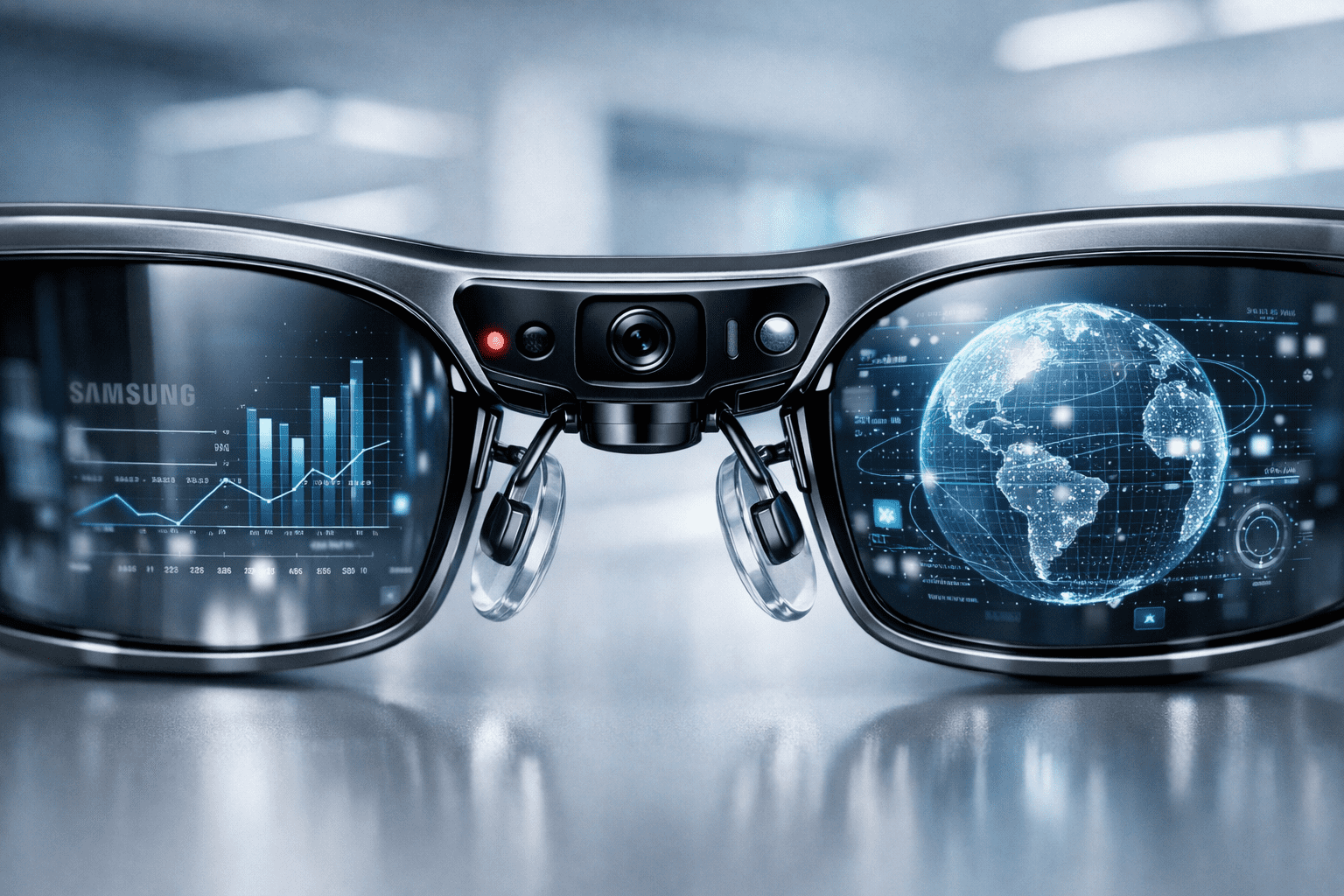
Samsung officially Enters the Spatial Computing Era with Galaxy XR Glass Launch
SEOUL, South Korea — The global race for spatial computing supremacy has taken a definitive turn. On February 12, 2026, Samsung Electronics officially commenced the mass production of its long-awaited “Galaxy XR” glasses, marking the tech giant’s first major foray into the extended reality (XR) hardware market. Developed in a strategic “triple threat” alliance with Google and Qualcomm, the device is projected to be the most formidable competitor to date for the Apple Vision Pro, promising a seamless integration of artificial intelligence and physical reality.
The Power of Sovereign AI and Next-Gen Chips
At the heart of the Galaxy XR lies a revolutionary architectural shift. To power the intensive demands of real-time spatial mapping and generative AI overlays, Samsung has deployed its latest “Made in Korea” sovereign AI memory chips. Unlike traditional processors, these chips are poised to handle “Agentic AI” tasks locally, reducing the need for cloud data transfers and ensuring ultra-low latency for the user.
Early reports from the production line in Gyeonggi Province suggest that the device utilizes Qualcomm’s Snapdragon XR2+ Gen 3 platform, specifically optimized for Samsung’s proprietary micro-OLED displays. These displays are rumored to offer a staggering 3,800 pixels per inch, potentially rendering digital objects indistinguishable from the physical world. While official performance benchmarks are still pending, early industry leaks suggest a 40% improvement in power efficiency compared to 2025 prototypes.
Design: Glasses, Not Goggles
The most striking feature of the Galaxy XR is its form factor. Eschewing the bulky “ski-goggle” aesthetic favored by competitors, Samsung has opted for a sleek, lightweight frame that resembles high-end eyewear. This “glasses-first” approach is poised to drive mainstream adoption, making the technology wearable for extended periods in professional and social settings.
The device features “Vibe Coding” integration, a new paradigm in software interaction where the user can modify their digital environment using natural language and emotional intent rather than complex menus. For instance, a user could simply say, “Make this room feel more productive,” and the glasses would automatically dim background distractions while highlighting work-related holographic widgets.
The Google-Android XR Ecosystem
The software backbone of the Galaxy XR is a specialized version of the Android “XR OS,” developed by Google. This ecosystem is poised to leverage the full power of the Gemini Nano Banana model, enabling real-time translation, object recognition, and “co-builder” capabilities. In a professional setting, two users wearing Galaxy XR glasses can collaborate on a 3D architectural model as if it were sitting on the table between them.
Furthermore, the glasses are designed to be the central hub of the Samsung Galaxy ecosystem. Based on early exit interviews with beta testers, the “Circle to Search” feature has been evolved into “Look to Search.” By simply gazing at an object and tapping the temple of the glasses, users can instantly pull up price comparisons, historical data, or technical specifications.
Market Impact and the “AI PC” Transition
The launch comes at a critical time for the technology sector. With traditional PC and smartphone sales stabilizing, the industry is pivoting toward “AI PCs” and wearable spatial devices. Analysts project that Samsung’s entry into this space could catalyze a $50 billion market shift by the end of the 2026 fiscal year.
However, Samsung is moving with cautious language regarding full autonomy. The company has emphasized that the Galaxy XR is currently “poised to complement” rather than replace the smartphone. This cautious approach is likely a response to the “AI productivity illusion” debates currently circulating in Silicon Valley, where critics argue that hardware must catch up to the lofty promises of AI software.
Security and Data Sovereignty
In an era of increasing concerns over data privacy, Samsung has integrated its “Knox Matrix” security suite directly into the XR hardware. The device includes a physical “privacy shutter” for its outward-facing sensors and uses encrypted “Geopatriation” techniques to ensure that sensitive spatial maps of a user’s home or office never leave the local device.
As mass production ramps up throughout February, the first units are projected to ship to global markets by early April 2026. The Galaxy XR represents more than just a new gadget; it is the physical embodiment of the “Agentic Reality” that tech leaders have been predicting for years. Whether it can truly dethrone the current market leaders remains to be seen, but for now, the eyes of the tech world are firmly fixed on Seoul.














1 Comment