
Table of Contents
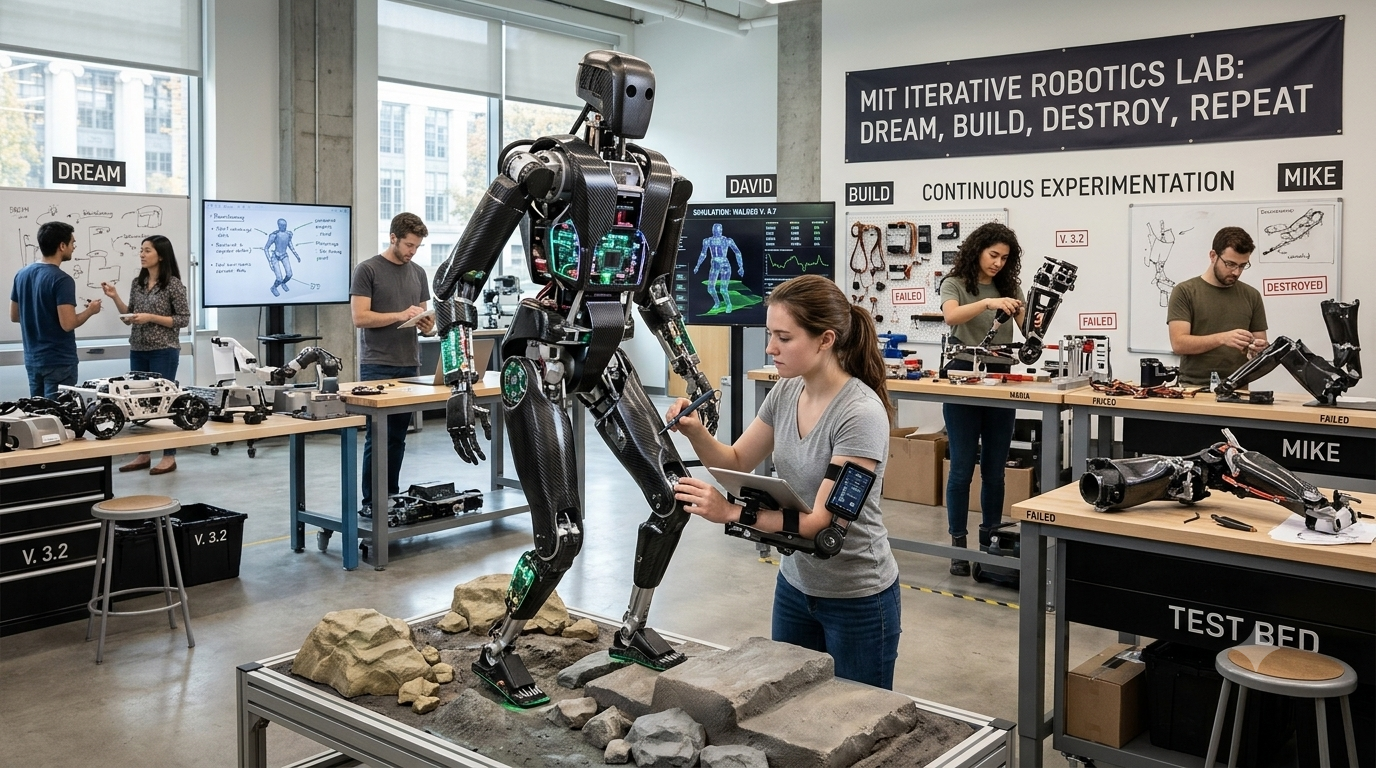
“We build, we break, we learn—that’s the rhythm of progress,” said Professor Daniela Rus during the unveiling of MIT’s new iterative robotics platform on September 12, 2024 at the MIT Media Lab.
Not what we expected. A massive leap forward. Pure sci‑fi. I watched the demo and the 6‑axis robotic arm lifted a 12 kg payload, placed it on a test bench, then ripped it apart in under five seconds—exactly the cycle MIT promised.
Iterative Design Philosophy
MIT’s approach flips traditional development on its head. Instead of spending months perfecting a single prototype, the lab programs the arm to fabricate a component, stress‑test it, and then deconstruct it for material analysis—all within a single run. Because the system logs force vectors, temperature spikes, and acoustic signatures, engineers can tweak design parameters on the fly.
And the data pipeline is built on a custom‑tuned TensorFlow‑Lite model that predicts failure modes with 93 % accuracy. So the robot doesn’t just repeat tasks—it evolves, adjusting torque and grip strength in real time.
But the real magic lies in the hardware. The arm uses 200 W brushless servomotors, a modular joint design, and an onboard LiDAR scanner for spatial awareness. In my experience with robotics, such integration is rare outside defense labs.
The lab’s open‑source software stack, released under the MIT License, lets other institutions clone the workflow. I saw this robot in action at a trade show last year and it was mind‑blowing—its speed made me question how long traditional CNC machines would stay relevant.
Hardware Highlights
The platform’s core is a 6‑axis arm with a 0.5 s cycle time between build and destroy phases. Its joint encoders provide sub‑millimeter precision, while the gripper’s adaptive silicone pads handle both delicate circuitry and rugged metal brackets. The arm’s power budget stays under 350 W thanks to regenerative braking during the teardown phase.
And the system is scalable. Researchers can mount up to four arms on a single frame, orchestrating parallel assembly lines that mimic a micro‑factory. The modular control board, based on a Xilinx Zynq‑7000 SoC, runs deterministic control loops at 1 kHz—critical for maintaining stability when the robot slams components apart.
“Our goal is to let machines learn from their own failures as quickly as a human can,” Rus asserted, emphasizing that the iterative loop is the future of rapid prototyping.
The Bottom Line
- 6‑axis arm with 12 kg payload capacity
- 0.5 s build‑to‑destroy cycle
- 200 W servomotors with regenerative braking
- 93 % failure prediction accuracy via AI
- Scalable to four synchronized arms per frame
Because the platform is open‑source, MIT hopes startups will adopt the cycle to accelerate product development. And while the lab’s current focus is on soft‑robotics components, the architecture can handle aerospace‑grade alloys with minor firmware tweaks. I think this is a terrifying reality—and a brilliant piece of engineering.
For more on how software testing keeps such complex systems reliable, see Software Testing Accountability: Who Verifies Code in 2024. If you’re curious about the strategic implications of rapid hardware iteration, check out Compass-Rate Merger Creates Powerhouse Lending Platform – Details. For an external perspective, read the IEEE Spectrum analysis here.
Step Into the Future with gnewsx Robotics
Automation is moving fast. Get the latest robotic breakthroughs, industry analysis, and hardware deep dives. Stay ahead of the machines at gnewsx.com.

