


President Macron Urges National Calm as Protests Erupt Following Fatal Beating of Student in Lyon
PARIS, France — A climate of profound political instability has gripped France this Saturday, February 21, 2026, as thousands took to the streets across the country to mourn the death of Quentin Deranque, a 23-year-old nationalist activist. The death of the student, who succumbed to brain injuries following a violent clash between rival political factions in Lyon, has become a flashpoint for a nation already simmering with tension ahead of next month’s municipal elections. Speaking from the annual International Agriculture Fair in Paris, President Emmanuel Macron issued a stern plea for “uncompromising” calm, even as he announced a sweeping government review aimed at dismantling violent activist groups.
The Lyon Incident: A Catalyst for Chaos
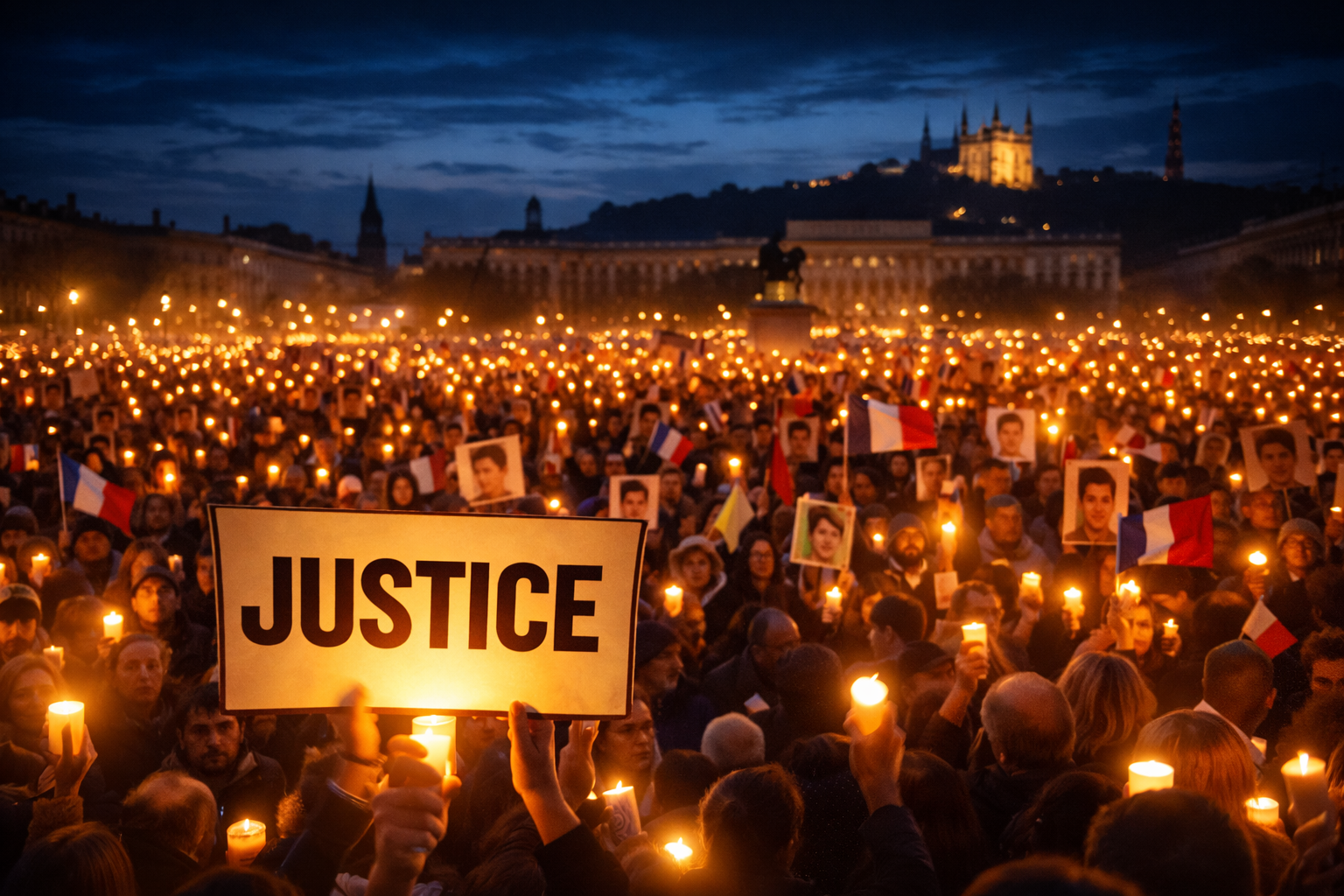
The tragedy began on February 14, during a heated protest outside the Lyon Institute of Political Studies. According to early reports, Deranque was part of a group of far-right activists who clashed with members of the anti-fascist group “The Young Guard.” The ensuing brawl resulted in Deranque being brutally beaten; he died two days later in a hospital. On Saturday, an estimated 3,000 people marched through the streets of Lyon, a city frequently described by intelligence services as the “cradle of far-right activism” in France.
The protests were not confined to Lyon. Similar demonstrations and counter-protests were recorded in Lille and Rennes, highlighting a deeply polarized electorate. Many demonstrators held placards reading “Justice for Quentin,” while some political commentators have gone as far as to describe the event as France’s “Charlie Kirk moment”—a reference to political assassinations that shaped the American landscape. The Lyon public prosecutor’s office has already requested that seven individuals be charged with intentional homicide and criminal conspiracy, six of whom are currently in custody.
Macron’s Response: Dismantling the Militias
President Macron’s appearance at the Salon d’Agriculture, traditionally a moment of rural celebration, was overshadowed by the national crisis. “In the Republic, no violence is legitimate,” Macron told reporters as he navigated the fairgrounds. The President is poised to hold an emergency meeting with his ministers next week to conduct a comprehensive audit of violent action groups that maintain links to established political parties.
Government insiders suggest that the administration is prepared to use executive decrees to dissolve organizations deemed to be functioning as “private militias.” Macron emphasized that the state must be “absolutely uncompromising” against those who seek to use violence as a political tool. However, the President’s critics suggest that the government’s response may be “too little, too late” to prevent the incident from being exploited in the lead-up to the 2027 presidential race.
Political Recriminations and the 2027 Horizon
The political fallout from Deranque’s death has been swift and vitriolic. The far-right National Rally, led by Jordan Bardella, has moved quickly to frame the incident as proof of “left-wing barbarism,” pointing to the arrest of a parliamentary aide linked to the far-left France Unbowed party. In contrast, Jean-Luc Mélenchon’s party has sought to distance itself from the violence, though sociologists suggest the damage to the party’s image may already be significant.
With municipal elections scheduled for March 2026, the “Deranque Affair” is projected to influence voter turnout and sentiment significantly. Political analysts are warning that the far-right appears poised to lead the polls, capitalizing on the narrative that they are the targets of systemic violence. Luc Rouban, a leading political scientist, noted that the weakening of state authority has allowed peripheral violence to multiply, creating a “culture of the street” that threatens the traditional democratic process.
A Nation at a Crossroads
As the sun sets over a tense Saturday in France, the heavy police presence in Lyon and Paris remains. While the tributes to Deranque passed without major new incidents of violence, the underlying fractures in French society remain exposed. The government’s upcoming review of activist groups is poised to be a landmark legal battle, as the state attempts to balance the right to protest with the necessity of public order.
For the citizens of Lyon and the family of Quentin Deranque, the focus remains on the judicial process. For the rest of France, the focus is on whether the Republic can maintain its core values in the face of rising extremism. The coming weeks will determine if Macron’s call for calm will be heeded or if France is entering a new, more volatile chapter of its long political history.








Leave a comment