


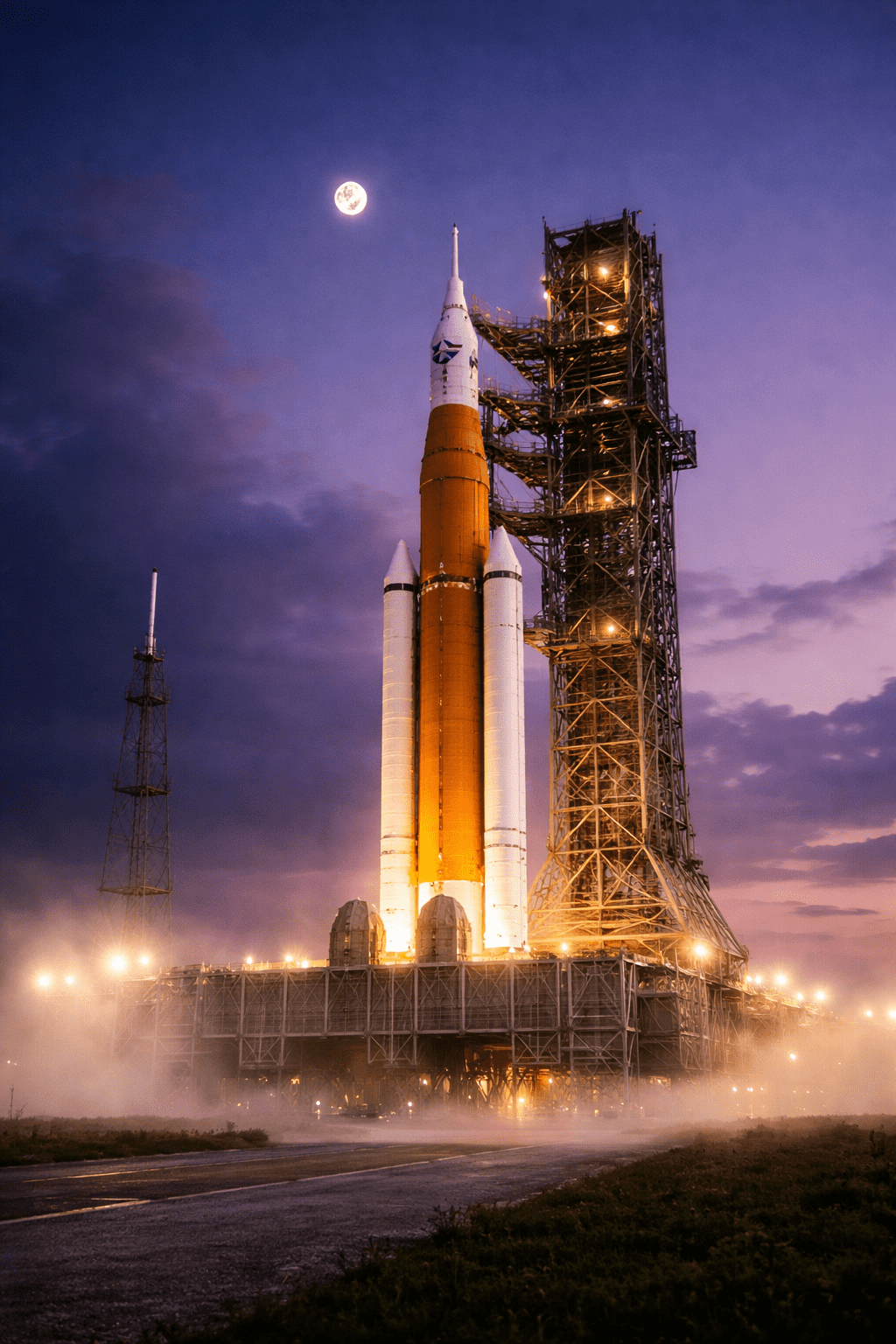
NASA Artemis II Poised to Return Humanity to Lunar Orbit for First Time Since 1972
CAPE CANAVERAL, USA — The frontier of human space exploration is on the precipice of a new era. NASA’s Artemis II mission, the first crewed flight of the Space Launch System (SLS) and Orion spacecraft, is projected to launch in the coming months, marking the first time a human crew will travel toward the Moon in over five decades. As of February 9, 2026, engineers at the Kennedy Space Center have entered the final stages of critical systems integration, ensuring that the four-member crew is prepared for the ten-day journey that will redefine the limits of deep-space travel.
Testing the Limits of the Orion Spacecraft
Artemis II is not merely a voyage of discovery but a rigorous test of the Orion spacecraft’s life-support systems. Unlike the uncrewed Artemis I mission, this flight is poised to validate the “Environmental Control and Life Support System” (ECLSS) in a high-radiation, deep-space environment. According to early reports from NASA’s flight operations team, the crew—Commander Reid Wiseman, Pilot Victor Glover, Mission Specialist Christina Koch, and Mission Specialist Jeremy Hansen—have successfully completed their final simulated emergency egress drills.
The mission profile involves a hybrid free-return trajectory. After reaching a high Earth orbit, Orion will use its service module to perform a Trans-Lunar Injection (TLI), swinging the crew around the far side of the Moon. Based on projected flight paths, the spacecraft will reach a distance of approximately 7,400 kilometers beyond the lunar surface, providing the crew with a perspective of the Earth and Moon that has not been witnessed by human eyes since the Apollo 17 mission.
A Diverse Crew for a New Generation
One of the most significant aspects of Artemis II is the composition of its crew, which reflects a modern, inclusive approach to exploration. Christina Koch is poised to become the first woman to travel to the lunar vicinity, while Victor Glover is set to be the first person of color on a lunar mission. Jeremy Hansen, representing the Canadian Space Agency (CSA), will be the first non-American to leave Earth’s orbit.
This diversity is not just symbolic; it represents a global coalition aimed at establishing a sustainable human presence on the Moon. The mission is viewed as a precursor to Artemis III, which is projected to land the first humans on the lunar South Pole. The data gathered during Artemis II—ranging from radiation levels inside the cabin to the manual handling qualities of the Orion capsule—will be essential for the safety of future landing missions.
Technological Hurdles and Cautious Optimism
Despite the excitement, NASA remains “cautiously optimistic” regarding the launch window. The agency has faced several technical challenges over the past 24 hours related to the heat shield’s performance data from the previous uncrewed test. While results are not yet official, the thermal protection system is being subjected to additional non-destructive testing to ensure it can withstand the 2,760°C temperatures expected during atmospheric reentry.
Furthermore, the integration of the European Service Module (ESM), provided by the European Space Agency (ESA), is being monitored closely. The ESM is the powerhouse of the Orion, providing electricity, propulsion, and air for the astronauts. Its performance is poised to be a deciding factor in whether the mission stays within its current projected timeline or faces further delays into late 2026.
The Lunar Gateway and Beyond
The success of Artemis II is a vital link in the chain for the proposed Lunar Gateway—a small space station that will orbit the Moon and serve as a multi-purpose outpost. This infrastructure is poised to support long-term lunar exploration and serve as a staging ground for eventual human missions to Mars.
International partners, including Japan and several European nations, are watching the progress of Artemis II with intense interest. The mission is expected to catalyze a new “lunar economy,” involving private companies such as SpaceX and Blue Origin, which are developing the landers and hardware necessary for the Artemis IV and V missions.
Final Preparations at Kennedy Space Center
As the SLS rocket stands on Launch Pad 39B, it represents the culmination of billions of dollars in investment and over a decade of development. The upcoming weeks will focus on the “Wet Dress Rehearsal,” where the rocket will be fueled with cryogenic propellants to test the countdown sequence. Any anomalies detected during this phase could shift the launch date, but NASA officials state that the hardware is currently “ready for the final push.”
The world awaits the moment when the four astronauts board the Orion capsule. For a generation that grew up after the Apollo era, Artemis II is the first tangible step toward becoming a multi-planetary species.













2 Comments